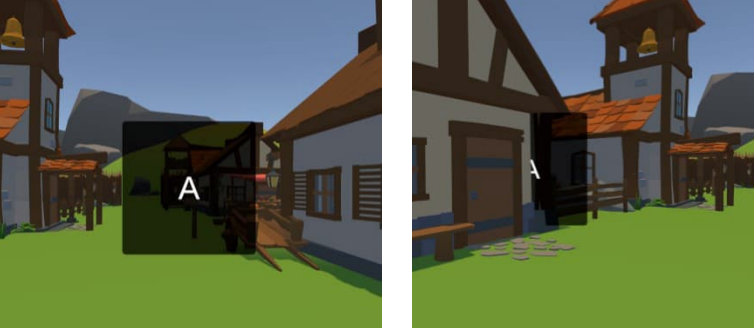
Auditory Presentation of Stimuli for Cognitive Load Dual Tasks in Redirected Walking
We presented an analysis of existing research on working memory (WM) tasks in Redirected Walking (RDW) to examine the feasibility of auditory stimulus presentation as an alternative to traditional visual displays prone to issues in richer virtual environments.
Redirected Walking (RDW) allows for natural locomotion in limited virtual spaces, but the unconscious cognitive impact of RDW on human cognition remains unclear. Existing publications typically display stimuli visually, which is prone to issues in richer virtual environments (VEs). Instead, an auditory presentation is proposed. We present an analysis of existing research on working memory (WM) tasks in RDW, indicating the feasibility of auditory presentation for verbal WM paradigms.
Overview
This research explores the application of auditory cognitive assessment within RDW through the following areas:
- Limitations of Visual Presentation: Analysing how visual UI elements encounter issues, cross geometry, or introduce contradicting depth cues when paths are curving or visually busy.
- Auditory Presentation Feasibility: Proposing auditory presentation for verbal WM paradigms that require a small set of stimuli to implement.
- Cognitive Modality: Evaluating evidence regarding whether visual or auditory presentation modes meaningfully alter encoding and cognitive processing on WM tasks.
Preliminary Insights
- The proposed solution of presenting auditory stimuli eliminates issues for verbal WM tasks in VEs with variable paths.
- The results of multiple studies on WM support the feasibility of the proposed auditory presentation with verbal working memory paradigms.